
- Buy in easy steps
- Premium Starts at INR 499
- Protect 100+ Crops
- Quick & Easy Claims
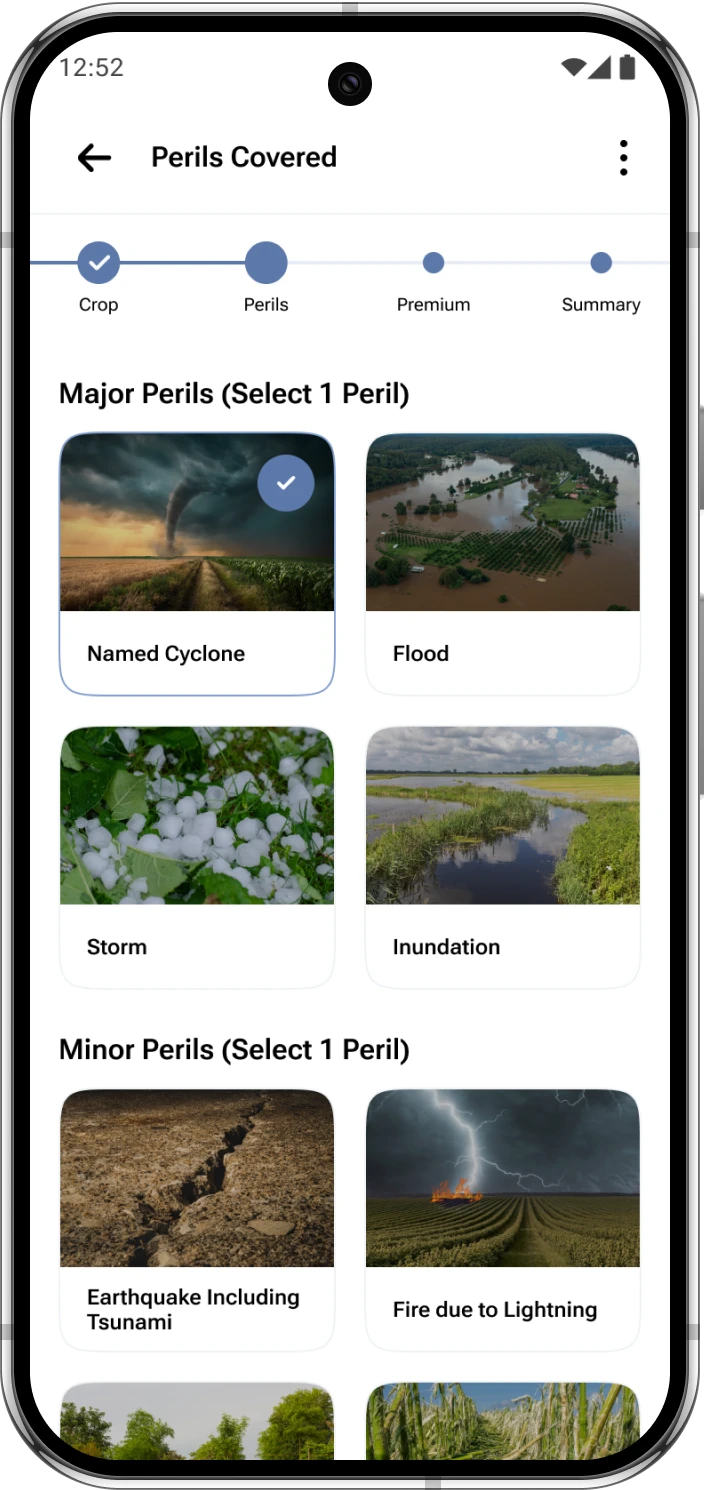
Why the Importance of Crop Insurance Cannot Be Overstated
Answer-first overview
- What is crop insurance?
Crop insurance protects farmers from loss of yield or revenue due to weather, pests, disease and other perils.
- Key benefits:
- Income protection
- Easier access to credit
- Faster recovery after disasters
- Incentivizing investment in improved inputs
- How it works (short):
Insurer assesses area-based or individual loss against expected yield or sum insured, then pays indemnity based on the policy type (area-based or individual).
- Who it’s for:
- Smallholders
- Commercial farmers
- Lenders
- Agri-businesses
- Immediate actions:
- Register on government or insurer portal
- Select a scheme (PMFBY / others)
- Keep records
- Notify losses promptly
Protecting Farmer Income and Livelihoods
Supporting Credit and Investment
Stabilising Food Supply and Markets
How Does Crop Insurance Work?
Step 1: Choose policy type:Area-yield/area-loss (like many government schemes) vs. individual farm-level cover.
Step 2: Insured Sum and Premium:Sum insured typically linked to expected yield or crop value; premium may be shared between farmer, insurer and government.
Step 3: Loss assessment and claim process:Area-based schemes use sampled assessments or satellite data; individual policies use field inspections.
Step 4: Claim settlement:Indemnity paid after verification — timelines vary by scheme and insurer.
Advantages of Crop Insurance
Financial Protection and Risk Transfer
Advantage for Small and Marginal Farmers
Advantage of Crop Insurance Schemes
Climate Resilience and Long-term Benefits
Crop Insurance in India — Key Schemes and Practical Tips
Major Schemes
How to Enroll
Documentation and Timelines
Choosing Between Area-based and Individual Cover
| Policy Type | How Loss is Assessed | Best for | Pros | Cons |
|---|---|---|---|---|
| Area-based (e.g., PMFBY) | Sampled area yield or satellite data | Regions with homogeneous farming | Lower admin cost, subsidised premiums | May not reflect individual farm loss |
| Individual farm-level | Field inspection and farm-level measurements | High-value or heterogeneous farms | More accurate compensation | Higher premium, more paperwork |
| Revenue/Price-linked | Combines yield and market price data | Commercial farmers facing price volatility | Protects both yield and price risk | Complex and costlier |
Common Causes of Farm Damage and How Insurance Addresses Them
Weather Hazards
Pests and Diseases
Other Risks (Fire, Post-harvest Losses, Market Price Drop)
Practical Checklist for Farmers Before Buying Crop Insurance
- Verify which crops and stages are covered
- Understand the sum insured and how it’s calculated
- Confirm premium amount and any subsidy available
- Know claim notification and inspection timelines
- Gather land records, input bills and identity documents
- Ask about use of remote sensing/satellite data and grievance redressal
Conclusion
Crop insurance is a practical risk-management tool that secures farmer incomes, strengthens credit access and increases resilience to climate and market shocks. For farmers in India and elsewhere, the right policy — chosen with attention to coverage type, sum insured and claim process — turns unpredictable farm losses into manageable financial outcomes. At Kshema General Insurance, crop insurance solutions are designed to support this financial resilience.
Take action: check available schemes for your crop, gather required documents, and enrol during the notified window to ensure protection before the next season.
Frequently Asked Questions (FAQs)
Q1. What is the importance of crop insurance for small farmers?
Q2. What are the main advantages of crop insurance schemes like PMFBY?
Q3. How does crop insurance work when my field is damaged by weather?
Q4. What benefits does crop insurance bring to farmers beyond payouts?
Q5. Can crop insurance cover farm damage from pests and post-harvest loss?
Disclaimer:
“We do not assume any liability for any actions undertaken based on the information provided here. The information gathered from various sources and are displayed here for general guidance and does not constitute any professional advice or warranty of any kind.”